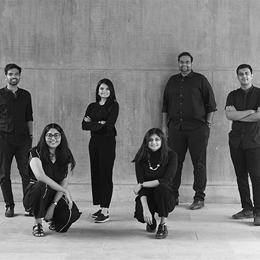
Sustaina India is a collaborative initiative between the Council on Energy, Environment and Water (CEEW) and the artist duo Thukral and Tagra. Positioned at the intersection of art, science, and policy, it seeks to advance climate action and deepen public understanding of sustainability in India. Through its fellowship programme and exhibitions, Sustaina India supports emerging artists in exploring ecological questions while fostering dialogue between research, creativity, and community
Studio Neogenesis was founded by Chinmay Laiwala, Jigar Asarawala, and Tarika Asarawala as a practice rooted in the idea that architecture must do more than build, it must create a sense of place. Over the last 14 years, the studio has grown into a dynamic design practice with a portfolio that spans master planning, housing, institutional and industrial projects, cultural and recreational spaces, commercial developments, and interiors.
What unites this breadth is a clear design philosophy: blending creativity with practicality, technology with tradition, and contemporary culture with timeless sensibilities. With each project, the studio strives to craft environments that are functional yet inspiring, enduring yet responsive, spaces that quietly elevate the everyday while carrying a distinct identity of their own.
Extreme heat places a disproportionate and, in many ways, an invisible burden on women engaged in unpaid domestic work like cooking and managing households. Unpaid domestic work is uncounted in economic data, while the stifling indoor heat of kitchens and living spaces remains absent from policy, hidden within private walls, and largely unacknowledged in public discourse. Indoor temperatures can often exceed outdoor ones, and in poorly ventilated, tin-roofed homes, routine domestic work becomes a health hazard. Co-created with women homemakers, this project aims to document their personal struggles with rising heat, and how women adapt with resourcefulness, finding small yet often inadequate ways to stay cool and ease discomfort. Through their voices, we glimpse their struggles, creativity, and the everyday strength that keeps homes and care going in a warming world.
Compartment S4 is a collective practice where architecture is not authored but assembled, shared across eight partners and three studios in Ahmedabad, Mumbai, and Bengaluru. Their work moves across scales, from homes to cities, landscapes to infrastructures, yet remains anchored in context and community. With expertise spanning the full arc of making, Compartment S4 stands for architecture as collaboration- open, adaptive, and always in conversation with the world around it.
Industhan is a design firm committed to creating innovative and sustainable buildings that respond to their context and time. The studio believes in sharing its knowledge and craft with young, curious minds, fostering a culture of collaboration and learning.
Rooted in the values of making and material honesty, Industhan’s work embraces traditional, handmade processes while engaging thoughtfully with new technologies. This dialogue between the artisanal and the contemporary defines their practice, crafting architecture that is both grounded and forward-looking.
Colorkari is a distinguished dyeing studio specializing in sustainable dyeing services for yarns and fabrics. With a commitment to transparency and environmental responsibility, Colorkari ensures every step of its process is traceable and safe. The studio uses only high-quality, eco-conscious dyes that are gentle on the planet and safe for human skin.
Working with a diverse range of natural fibers, including cotton, hemp, linen, khadi, silk, wool, muslin, bamboo, and lotus, Colorkari offers both versatility and precision. Their use of 100% Azo-free and natural dyes results in vibrant, enduring hues that retain their beauty over time.
Experts in color matching and customization, the team works closely with Pantone and other shade systems to bring each client’s vision to life. By blending traditional craftsmanship with modern sustainable practices, Colorkari creates textiles that are as responsible as they are beautiful.
Edible Issues is an India‑based collective working at the intersection of food, culture, and climate, exploring how our choices shape the future of food systems. Through research, installations, storytelling, and workshops, the collective examines food justice, biodiversity, labour, circularity, and culinary heritage, creating spaces for dialogue and experimentation.
By connecting creatives, researchers, and practitioners, Edible Issues fosters a collaborative community that reimagines how food can sustain people, planet, and culture. Projects such as their open‑library installation invite participants to engage with the past, present, and future of food, inspiring actionable ideas for a more resilient and equitable food system.
Founded in 1995 and based in Bengaluru, Flying Elephant Studio is an architectural practice with a portfolio spanning educational institutions, research facilities, museums, industrial buildings, apartments, and residences. Over the years, the studio has earned recognition through competitions, awards, publications, and exhibitions for its sensitive and contextual approach to design.
Flying Elephant Studio is drawn to architecture that offers refuge, comfort, and delight, while fostering a sense of community. With a place-responsive and climate-conscious design ethos, the practice also explores urban infrastructure solutions that anticipate the challenges of extreme weather.
Led by Rajesh Renganathan and Iype Chacko, both CEPT Ahmedabad alumni and registered architects with the Council of Architecture (CoA), New Delhi, Flying Elephant Studio brings over three decades of diverse professional experience and a commitment to shaping spaces that are humane, enduring, and adaptable.
GoodKarma Farms is a five‑acre organic farm located in Alibaug, Maharashtra, dedicated to producing healthy, delicious food in harmony with nature. Their mission is to bring purpose, pride, and prosperity back to farming, ensuring that the freshest, most nutritious produce reaches those who need it most. Innovation, sustainability and community are at the heart of GoodKarma’s approach. Through regenerative agricultural practices, water‑management systems, and low‑waste production, the farm explores how food, land and people can connect in ways that heal and uplift. They also run workshops and farm‑to‑table experiences, inviting participants to engage directly with the land, understand how food is grown, and reconnect to the origins of what they eat.
Made in Earth studio brings together artisans, architects, engineers, artists, and makers united by a shared passion for creating. Guided by a love for natural materials, clay, lime, rice husk, straw, and earth, the studio explores both traditional and contemporary processes to craft spaces that are circular, inclusive, and connected to place.
Research, both material and cultural, drives their work, engaging with traditional knowledge to reinterpret and reimagine craft for the present. Comfortable moving between the drawing board and the earth pit, the team builds everything from brick vaults to bamboo walls. Every project is chosen thoughtfully, fostering learning, experimentation, and deep ties to people, community, and ecology.
The Heritage Project (THP) is an initiative dedicated to the preservation, promotion, and revitalization of India’s cultural heritage. It views heritage not merely as something to be conserved, but as a living, evolving force that can build more inclusive, resilient, and connected communities.
THP’s work spans research, community engagement, collaborations, and creative interpretation, making heritage accessible and relevant to diverse audiences. Through rigorous documentation, the team creates reliable archives that inform conservation and advocacy efforts. Its community-first approach involves residents, youth, and cultural custodians in co-creating programs rooted in local realities. By collaborating with government bodies, urban planners, and academic institutions, THP develops scalable models of heritage management that balance technical rigour with cultural sensitivity.
IBUKU is a Bali-based design studio redefining sustainable architecture through bamboo. Founded by Elora Hardy, the practice combines ancestral Balinese craftsmanship with modern engineering to create homes, schools, and community spaces that breathe with nature. With over 60 built projects worldwide, including the iconic Green School, IBUKU envisions design as a path to resilience, wellbeing, and a renewed relationship with the earth.
The National Centre for the Performing Arts (NCPA), Mumbai, is India’s premier cultural institution. Inaugurated in 1969, it was the first multi-venue, multi-genre cultural centre in South Asia. The NCPA is committed to preserving and promoting India’s rich and vibrant artistic heritage in the fields of music, dance, theatre, film, literature and photography, as well as presenting new and innovative work by Indian and international artists from a diverse range of genres including drama, contemporary dance, orchestral concerts, opera, jazz and chamber music. Today, the NCPA hosts more than 700 events each year, making it India’s largest and most holistic performing arts centre.
Skidmore, Owings & Merrill (SOM) is a global collective of architects, designers, engineers, and planners shaping the future through deeply interdisciplinary practice. Founded in 1936 on the belief that design thrives through collaboration, SOM integrates art, engineering, policy, and urban strategy into every project. As a net-zero emissions business, the firm leads global standards for low-carbon, regenerative architecture—advancing climate action through research, innovation, and transformative city-building.
Asad Lalljee is the Senior Vice President of Essar Group, CEO of Avid Learning—a public programming initiative and creative platform under the Essar Group—and Curator of the Royal Opera House, Mumbai. Before relocating to India, he spent 14 years as one of the ‘Mad Men’ advertising executives on New York's Madison Avenue. Asad has transformed Avid Learning into India’s leading cultural hub through international collaborations and partnerships with the country’s biggest art platforms. Since the restoration of the Royal Opera House, his curatorial programming has re-established its reputation as the city’s cultural crown jewel. He has been a member of the prestigious Federation of Indian Chambers of Commerce & Industry's Art and Culture Committee since 2018 (now FICCI's Tourism and Culture Committee), co-convening national conferences on the creative economy across Kochi, Bengaluru, Mumbai, and New Delhi. He also serves on the Executive Committee of the Kala Ghoda Association and the advisory board of the Mumbai Urban Art Festival. Amid the pandemic (April 2020), Asad pivoted from Avid Learning to Avid Online, presenting 240 programs in a year. An early adopter of technology trends, he specializes in new media, curating programs around AI and the cyberfuture. Asad holds a B.A. in Economics from St. Xavier's College and an M.A. in Global Marketing Communications from Emerson College, Boston.